The salivary glands are important, as they create saliva, which is vital for eating and breaking down food, which in turn helps with digestion. But did you know that they also are important for overall oral health. Here’s what salivary glands are, and what they can do for saliva creation and production as well.
What they Are
These are small glands that create saliva and are responsible for the secretion of this within your mouth. This is used to help with many things.
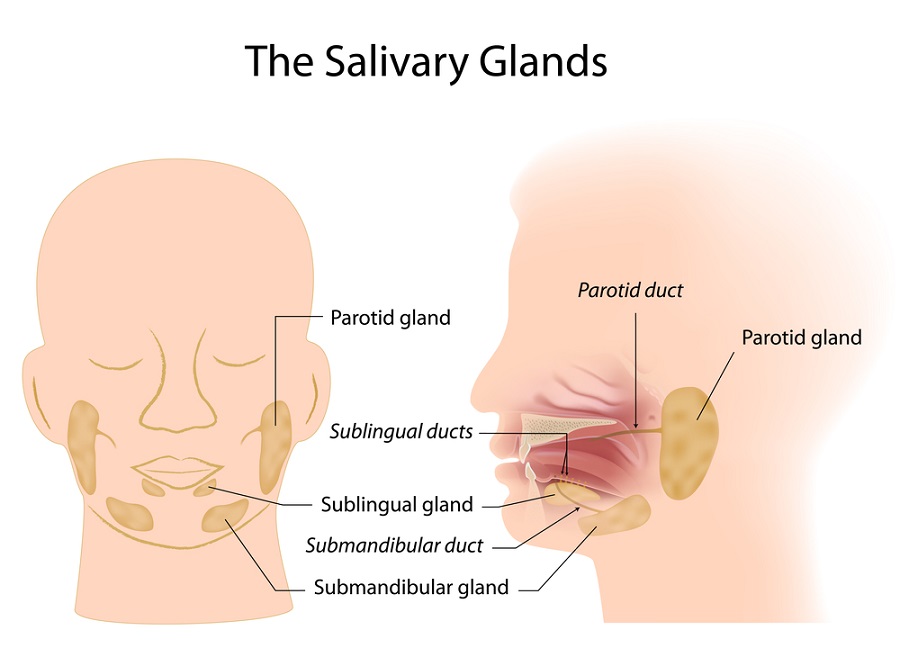
The parts are the following:
- Parotid glands: the largest glands that are on the sides of the face, in front of your ears. They empty out the saliva to your mouth, near those three molars
- Submandibular glands: these are rounded glands below the jawline. They secrete this saliva into the mouth underneath the tongue
- Sublingual glands: the smallest ones, and they’re an almond shape that’s underneath your mouth floor. They are able to empty out near where the tongue junction and the mouth floor are
There are hundreds of other different glands that exist within the digestive tract. The glands are incredibly tiny so you can see them with the naked eye. They show up along the lip lining, within the inside of those cheeks, and a lot of other great places.
How they Work
They create the saliva in order to keep the digestive system and tract nice and moist.
When you have something touch the tongue or the mouth, or you have to chew, you increase your saliva. While you eat, saliva is good for lubricating this food in order to pass this through to the esophagus along with the stomach quickly and readily.
There are also some enzymes that work as well to aid with digestion stages, in order to soften and furthermore break these down especially if your body needs to use that energy and then store it.
Saliva plays a focal part in the oral health of a person. It’s made with different minerals designed to lower the acidity within the mouth. This is a process that’ll keep the enamel of the tooth from wearing itself down, and more cavities that are forming. Saliva also works to wash the food debris that’s there away, and also prevents that bacterium from eating the enamel.
Salivary Gland Disorders
If you don’t have enough saliva, you’ll suffer from a condition called xerostomia, otherwise known as dry mouth. This increases your chances for tooth decay, breath that’s bad, and issues with digestion. Because your glands secrete some saliva through a small opening near the end of this like a tube, it can cause them to be inflamed and blocked, impacting saliva flow.
There are also salivary stones, which is known as sialolithiasis, and this is where the deposits of hardened minerals form within the ducts of your glands, stopping saliva flow. This causes your glands to swell on up, and also will make them infected. These stones can be treated through the application of heat and drinking water. If the stone gets too large, you may need to talk to a dental professional.

There are also tumors and cysts too, which are rare. Most of these tumors are not harmful, and they usually involve the parotid glands, and cysts are sometimes there when you get infections, stones, or injuries.
In the case of tumors, they’re removed via surgery, and many times, cysts are drained in order to help with them.
Salivary glands are important, so make sure to keep them healthy as much as you can for your own health and wellness.
 Mouth Health