Effective Ways for Removal of Biofilm 

Biofilm is that technical term for the plaque that’s on top of the teeth, white and sticky. Removing this biofilm from the tissues and the gums is vital for one’s oral health, and here, we’ll give you the best ways to remove it.

What biofilm is 

This is a layer made up of bacteria that happens inside and outside of the body. It’s a plaque that forms on the teeth and gums, and when not treated, it causes cavities, gingivitis, and gum diseases. 

Plaque does need to be removed because it can create tartar if you’re not careful. This is calculus, which you’re unable to remove at home. So yes, get rid of it now to save your teeth at the dentist. 

With that said, here are some biofilm removal means to use right now! 

Brushing 

The most obvious, but you should brush with  a soft-bristled toothbrush for two minutes, two or three times a day for plaque removal. Most who don’t brush their teeth  are going to very superficially do this, so the biofilm will be there on the gumline and teeth.
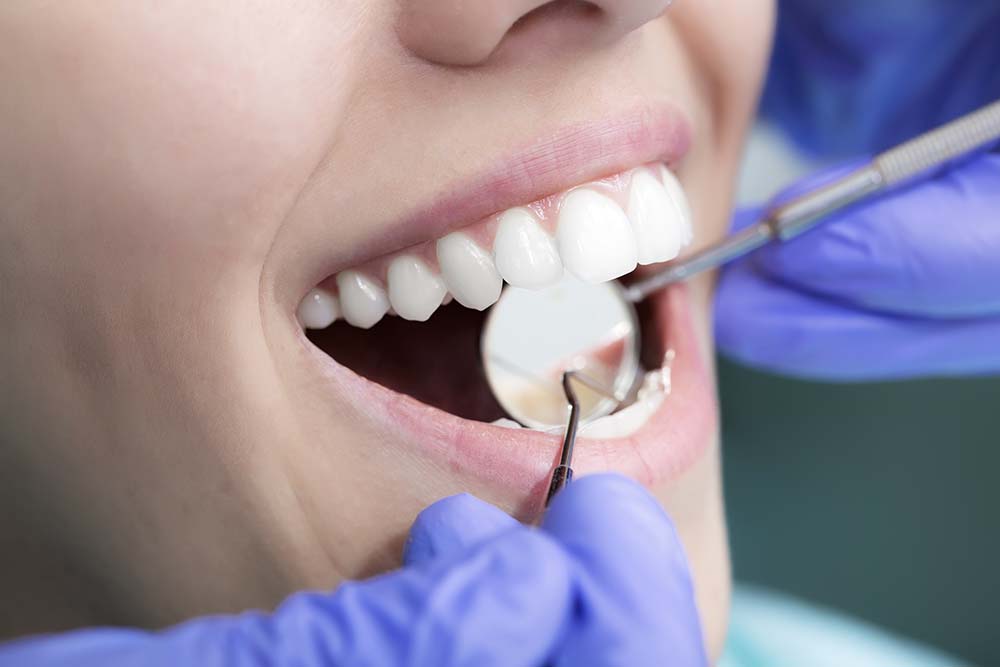
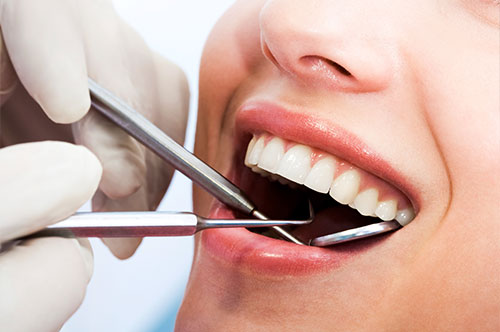
Young woman patient at dentist’s office – Closeup picture taken with macro lens

After meals are good, and setting up the timer for two minutes is good. Brush with fluoride toothpaste so that you can reduce the plaque bacteria’s acids that are harmful. It also naturally injects minerals in there that are otherwise removed from your enamel.

When brushing, utilize some short back-and-forth little strokes or circles to clean these outer surfaces, inner parts, and chewing surfaces for all the teeth.

Remember to try to brush around the gumline on the back teeth. These are often skipped, so being diligent about it now will save you a massive headache later on.

Flossing 

Another habit that’s skipped and it should not be, because brushing does not remove everything, since it does build  up between the teeth areas, or underneath the gum line and other harder to reach areas that toothbrushes are limited too.

Flossing once a day with a flosser, interdental brushes, for a water flosser is good.

Some people may struggle with this, but you have to do this. if you’re still having issues, talk about other means, and ask for demonstrations to ensure you’re good. 

Pro cleanings 

Professional cleaners remove bacteria. 

Even when you floss and brush on the regular, you cannot remove the bacteria fully. When that remains on the tooth area, you suffer from gum disease and oral health issues. 

In general, you should get cleaned every six months. They will look and remove the plaque and tartar that are above and below. That way, they can find the hidden plaque and get you cleaned up! 

Mouthwash 
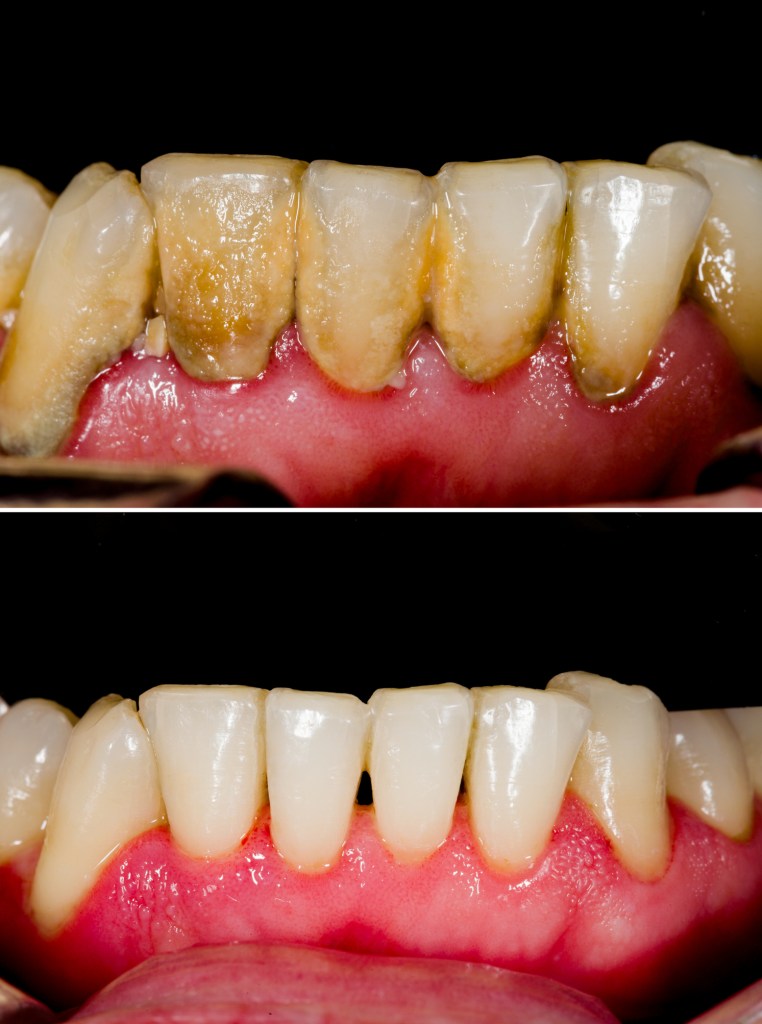
Mouthwash contains a lot of ingredients designed to prevent or get rid of biofilm. Fluoride for example is a huge anti-plaque component, and is used for strengthening the enamel, and protection against your cavities. 

Do this once daily, after tooth brushing, so you don’t fully remove the fluoride added. 

Lifestyle and Diet 

Bacteria love sugars and starches. So yes, if you eat a lot of cake, soda, and candy, you’ll get these. The same goes for chips, crackers, and bread. 

Enjoy all of this in moderation. 

However, also be mindful of other types of harmful activities, such as smoking tobacco, because this messes up the bacteria, and restricts the flow of oxygen to the gums, and makes it easier for the plaque and bacteria to grow. If you’re smoking, try to quit, or use alternative means to help you get off the cigarettes. 

It can be removed. All biofilm has a chance to be gone, but it’s up to you to get rid of it. 

A Brief history of Dentistry 

Dentistry has come a long way, and here, we’ll go over some of the different historical practices that were used, and what was done to take modern dentistry to where it is today.

Ancient Techniques 

Density is actually a very old medical practice, with it dating all the way back to 79000 BC, and seen in the Indus valley.   However, the descriptions of tooth decay were first seen in Sumerian texts. However, these were wrong, and they talked about tooth worms that caused tooth decay. Obviously, that isn’t the case.

However, Aristotle and Hippocrates did write about the treatment of decaying teeth. Back then they used fine-tooth combs, in order to ensure that their teeth were cleaned. These were made from the hair of animals. They also used toothpaste, but tit was a very abrasive product. 

The Middle Ages 

The middle ages saw some dentistry as well, except these were in the form of magic and myths, which have since been disproven.

Back then people thought that teeth were magical items.   They were also used to protect a child from fairies. 

The Europeans did believe that witches would curse people with their teeth, so they would dispose of them either through swallowing, burying, or even burning their teeth. Some fed them to rodents, or were even just thrown out. 

Tooth decay was again thought to be caused by a tooth worm, which they thought burrowed into a tooth like it did with wood.  Some of the remedies for this were interesting.   While some were more normal like burning candles made of eryngo seed and sheep suet near the teeth, others were quite interesting, such as kissing a donkey, as purported by Germanic legend. 

Some even said they should not clean their ears, as the practitioners did advise against cleaning up the ears to prevent this. obviously there was a lot of false information which would not be disproven for another few centuries. 

The Beginning of Modern Dentistry 

Remember the idea of tooth worms? Well that was thought to be a thing until the 1700s! However, in 1530 there was a little medicinal book that talked about the infirmities of the teeth, which was devoted to dentistry.

The first dentists were seen in the 1700s, with Pierre Fauchard in 1723, being the father of modern dental practices.   He wrote a whole comprehensive means for treating and caring for teeth. He was also the first to introduce fillings, and dental prosthesis. He also figured out that sugar and acids were what caused dental decay.

The first dental college was founded about a century later in 1840, and this was the Baltimore college of Dental Surgery, which was something that seemed to be popular back then.   The ADA was formed in the 1860s, 20 years before the first dental practice was founded in Alabama. 

Then of course, the first dental institution and university was the Harvard University Dental School, which they founded back in 1867. 

Colgate was the first to make modern toothpaste, which was made in 1873, and toothbrushes were founded a few years after that. 

The first x-ray was used in 1896, and more systems for crooked teeth developed here. Obviously, when we look at where it’s come today, we have a lot more to work with.

Various cleaning devices that get deep like the cavitron are popular. There’s also various technology to see directly any malicious tissues, such as cancers and growths.   With the evolution of dental care, we see how far it’s come, and how through this constant evolution, we are able to care for more people than ever before. 

Women’s Hormones and Oral Health 

Women’s hormones affect a lot of things. Did you know that it also includes oral health? Yes, estrogen, progesterone, and even menopause affect your oral health, which is why here, we’ll talk about what can happen if you’re not careful. 

Puberty, Progesterone, and Gums 

Young girls may not notice the changes to their oral health, but puberty causes many physical changes. The biggest ones are estrogen and progesterone. This creates gum sensitivity and the possibility of germs creating problems. 

If not taken care of, such as through regular checkups, brushing twice daily and flossing once a day, it does lead to infection, redness of gums, bleeding and swelling, and may cause gingivitis. 

Menstruation and Oral health 

Every month women who are of childbearing age who aren’t pregnant deal with menstruation. We think about the cramps, bloating, and emotional effects. But there are hormonal changes throughout the menstrual cycle that create oral health changes. 

Sometimes canker sores, salivary glands being swollen, red gums that are swollen and bleeding gums all can happen right before a woman can get their period. Menstruation gingivitis, while rare, does happen right before one gets their period, and will clear up after. While temporary, this can lead to long-term problems if you’re not careful. 

Pregnancy and Gingivitis 

Pregnancy causes a lot of changes to a woman’s body. The biggest one is the immune response.   Sometimes, women’s immune systems go into overdrive, and can lead to sensitivity in many areas, including the gums. Pregnancy gingivitis is quite common, especially during the second and third trimester of pregnancy.   Getting regular cleaning and checking with your dentist on the same level as you would with the obstetrician and gynecologist during this phase of life is important.

Sometimes, gestational diabetes happens too, which can also negatively affect the gums and oral health

Menopause 

Menopause is when a woman stops producing her own estrogen. This is also when a woman stops getting her period as well. it can create changes in a woman’s oral health, especially due to the sudden drop of hormones. A changed taste, burning in he mouth, sensitivity to hot and cold, and even less saliva tends to happen to women during menopause. Definitely talk to your dentist if you have issues with your oral health, especially after this stage in life. 

Hormonal Birth Control Concerns 

Finally, there’s hormonal birth control. They do come with side effects, sometimes quite excessive. In some cases, it does lead to dry mouth for some female patients. The best thing to do is to talk to your dentist and if they notice this, get the help you need right away.

Take Charge of your Oral Health Today! 

As a woman, it’s vital to start taking care of your oral health the second that you realize there is a problem. Even when reading this, you should start to maintain your oral health.

Make sure to brush twice daily, but use a toothpaste containing fluoride.   Rinse and floss once a day, preferably with an alcohol-free mouthwash so it doesn’t dry out the mouth even more.

Try to go to the dentist twice a year for cleanings and exams. That way, if there is something going wrong, they can take care of it right then and there. 

Make sure you’re eating a diet that’s well-balanced, with plenty of fruits and vegetables.   Make sure you’re also eating foods that aren’t too sugary or starchy as well, as that will feed the bacteria. Try to drink as much water as you can too, in order to flush out that harmful bacteria that appears. 

Natural Remedies to Prevent Cavities 

There are a lot of ways to prevent cavities. Eating well, drinking water, and the like.  Natural ways to prevent tooth decay is important, sometimes almost more important than the natural ways. 

Here are some natural remedies that will allow you to prevent those cavities. We’re going to explore food that you should eat, various herbal remedies worth looking at, and finally, actions you can take in order to prevent cavities. 

Foods for Cavity Prevention 

The first is foods that you have to prevent cavities. Now, because of this, we’re not saying they will automatically prevent this, but they strengthen your enamel in order to prevent further cavities in the future.   

The first is dairy. This is because of the calcium, which is used to strengthen bones and teeth. Very good for strengthening your enamel, and overall preventing tooth decay.

Leafy greens are another. Leafy greens contain B and D vitamins, which are good for prevention of tooth decay.

Nuts are a third one.  Nuts offer a lot of unique vitamins, proteins, and the like. It keeps you full too, so you’re not over here trying to eat something bad. Sugary foods are definitely something to avoid, since in a lot of cases, it can be something that will cause more decay.

Many people eat too much sugar. Sugar is the natural killer, and it’s why a lot of people are having tooth issues. This is because of their teeth, and not taking care of them.   but, when you eat right, you’ll be able to prevent this. 

Herbal remedies. 

Herbal remedies are another. The basis for this is that they do naturally fight bacteria. They are anti-inflammatory, and antimicrobial, which is used to kill the bad bacteria, writing them in its place. These remedies are a little bit divided if they work, but they are something which, for many people, is a good way to fight cavities. 

Oil pulling 

Finally, there is oil pulling. This is where you take oil and swish it around in your mouth. While it might seem silly, this actually helps with tooth decay because it pulls all of the germs away from your mouth. When everything’s pulled it then gets rid of a lot of the decay.  You spit it out, and the oil then gets rid of those germs. 

Baking soda as well is used with this. Baking soda is also good for a lot of tooth decay preventative measures. This is because baking soda is abrasive, and is good for cleaning even the worst stains. Bear in mind that if you do use this, try not to overuse the item, because the abrasiveness will wear away the enamel that’s there. 

Overall, this is not the only way to prevent tooth decay, but it is a measure you can take, in order to improve your oral health. 

Complement, not Replace 

All of these natural remedies are complements for your oral health care routine. No, do not replace your oral care routine with this. 

You want to make sure that you still go to the dentist for check ups multiple times a year, and also brush your teeth every day, and floss your teeth as well. a healthy diet and regular oil pulling, however, can work to keep your teeth looking nice and shiny. Knowing this, you’ll be able to have the best oral health that you can, and in turn, make sure that you’ve got a bright smile that will last a long time!